
ARCHIVE OF DRIFTING → 3000 SHEETS or OPERATION REISSWOLF
Description of an unrealised residency project by Otmar Wagner, developed for the Academy of the German Festival IMPULSE
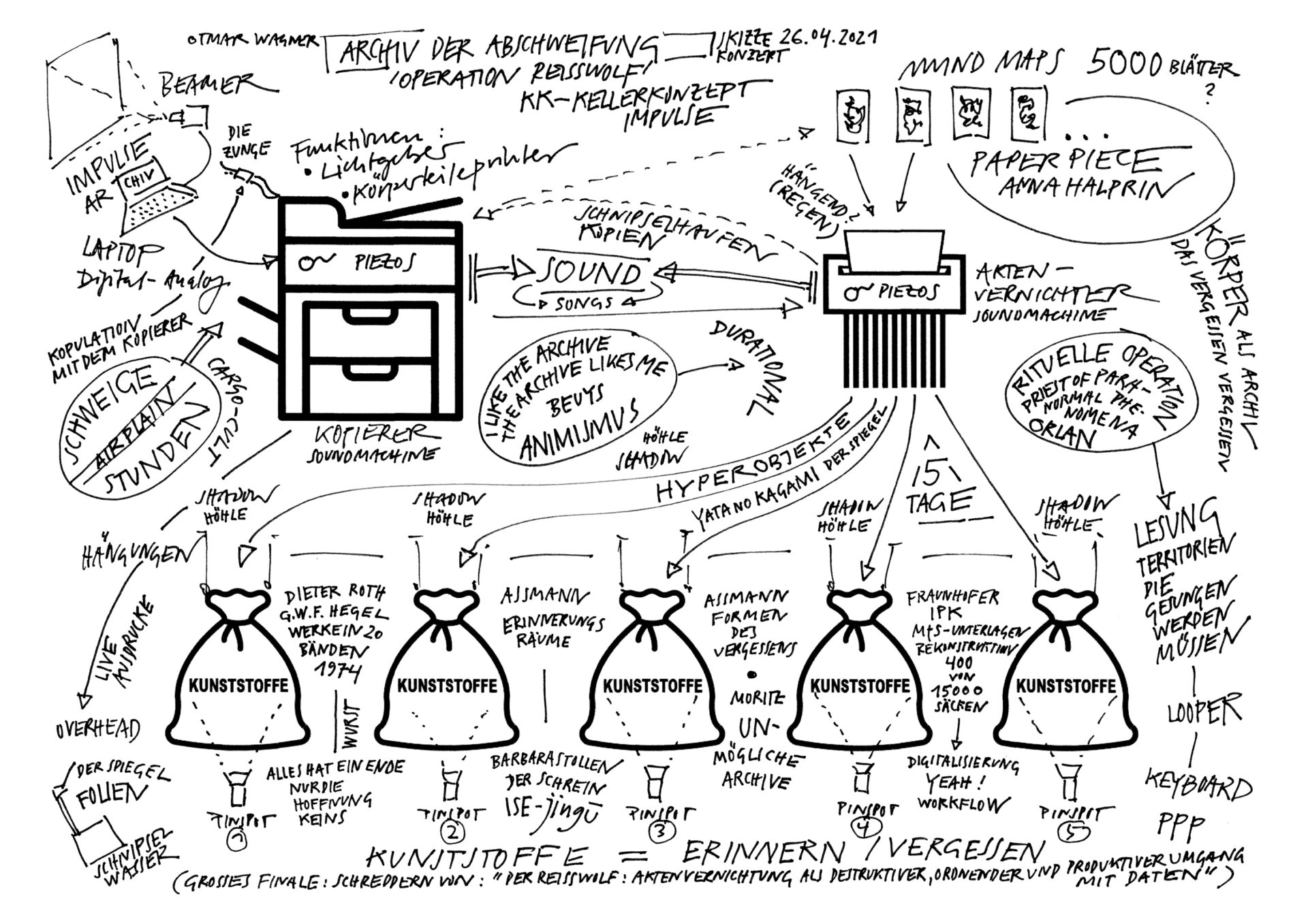
This project is an open-ended, five-day ›durational performance‹ based on a simple conceptual approach: printing out digital data - arranging the sheets of paper in the space - performing actions involving the texts and images, as well as additional equipment - shredding the paper - filling and hanging the sacks with the scraps.
»What I find truly interesting here is not the process itself, but what happens in open artistic research with, through and between the different parts of the performance – the changes in the state and atmosphere of space / material / performer.«
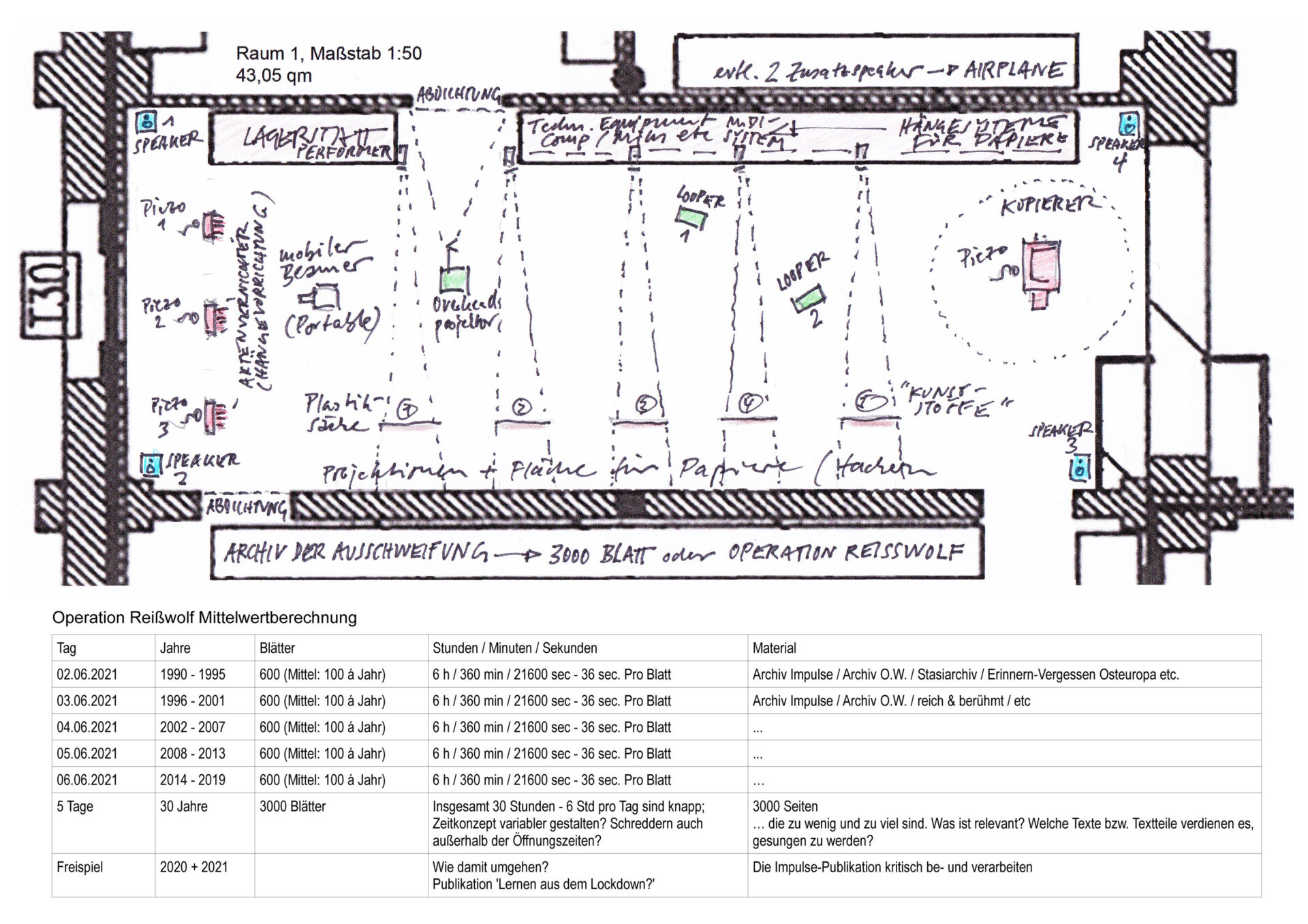
Due to the pandemic, the festival was postponed from 2020 to 2021. In spring 2021, new premises were found for the Impulse Academy. As a result, the concept originally developed under the title ‘ARCHIV DER ABSCHWEIFUNG’ (Archive of Drifting), featuring mobile walls made of ›analogue Dropbox folders‹, was significantly altered in favour of a site-specific approach and renamed ›3000 Sheet or OPERATION REISSWOLF‹.
The shelving units in the claustrophobic-looking basement rooms are used as a storing place for the performer, technical equipment and projection apparatus. A floor-standing copying machine, several document shredders suspended in the room, and transparent bags with the inscription ›KUNSTSTOFFE‹ form further elements of what initially appears to be an orderly spatial installation – complemented by a mobile camera-projector unit and an overhead projector.
The devices and spatial elements are largely fitted with contact microphones – their noises and sounds are fed into a sound-processing system comprising loopers, harmonisers and sound modulators, where they are musically processed and transformed. The space becomes a soundscape.
The digital text material collected in advance consists primarily of programme book forewords, interviews and accompanying texts, press articles on the Impulse Festival, as well as general theatre debates from the respective years (material devoted to ›Reflections on Independent Theatre ‹ – to quote the subtitle of an Impulse publication), supplemented by foundational literature on archives, memory and forgetting, such as Aleida Assmann’s ›Spaces of Memory‹, Peter Melichar’s ›Dead and Living Archives‹, Feigl & Schröder on ›Performance + Archives‹, Freud’s ›Note on the Wunderblock‹, Günter Butzer et al. on ›Cultural Forgetting‹, Wehren’s ›Reflections on the Body as Archive‹, Zeilinger’s ›On the Political Significance of Memory‹, Kastberger et al. on the ›Archive as Venue‹, and Lars Moritz’ ›Performing the Archive‹.
The process of analogisation and processing, right through to the shredding of the material, is carried out in ›ritualistic‹ acts – it's not about an analytical aesthetic, but about a pseudo-ritualistic one.
»The approach is to evoke and exorcise animistic and ritual forms – the arrangements of objects allude to altar installations, whilst the performative actions refer to ritual incantation practices. My aim here is a ›strategy of affirmation‹ (Bazon Brock), a subversion through exaggeration and a balancing act between pathos and banality.«
The auditory processing of the textual and visual material takes place on several levels, which will be explored during the residency in Düsseldorf. In doing so, Otmar Wagner refers to his concept of ›territories that must be sung‹ – texts as spaces of memory brought to life through sound.
»The space is an operating theatre (Orlan), a space for action (Joseph Beuys) and a bunker following the Third World War (Heiner Müller). Perhaps, in the process of converting digital material into analogue material and the physical transformation of this analogue material, further actions will emerge through the experimental handling of the material and the instruments. I can imagine that it will be necessary to thoroughly penetrate the photocopier and subject the document shredders themselves to destruction.«
In mid-May 2021, Otmar Wagner decided not to go ahead with the project due to the ongoing uncertainty surrounding the COVID-19 situation. Instead, Wagner took part in the Zoom Archive Talk Vol. 4 on the topic of ›Archive & Rubbish» – with Paolo Bianchi (cultural journalist, creativity researcher), Wolfgang Stöcker (International Dust Archive), Lucie Strecker (artist), Otmar Wagner (artist), moderated by Thomas Kaestle. Meanwhile, cultural researcher and dramaturg Henning Fülle conducted a 90-minute video conversation with Wagner in his studio in Vienna from the venue of the planned performance in Düsseldorf. It was posted online during the 2021 festival. Now it's available here.